Lughnasadh and the First Offering

Lughnasadh arrives on August 1, and most of what gets written about it calls it a thanksgiving. The first loaf on the table, the corn dolly braided from this year’s straw, and thanks given for the grain. I kept the festival that way for years, but sometimes that framing feels too small for the weight of the day.
.

The name remembers an older layer.
Lughnasadh means the assembly of Lugh, and the first assembly was a funeral: Lugh founded the games for Tailtiu, his foster-mother, who cleared the plains of Ireland for the plough and died of the labor. The oldest thing in this festival is her death, and every loaf of August bread comes off ground she paid for with her life. She deserves more than a paragraph, and she’ll have her own post this season. For now, it’s enough to know the festival was born at a graveside, and when the first bread is on your table, to say her name.
So gratitude is real at Lughnasadh, but it comes second. Gratitude is what remains once the harder thing has been done.
To gather a crop is to cut it. The grain comes down at the height of its ripeness, and only then does it become bread.
Before the season asks whether you’re thankful for what grew, it asks whether you can let it be cut down.
That question follows you home from the field. Something in your life right now is ripe. A piece of work that’s finished whether or not you keep polishing it. A decision you’ve already made but not yet acted on. A season in your life that’s over, yet you refuse to let turn. You know which one it is, because it’s probably the thing you’re most weary of holding.
Ripe things don’t keep for long. Grain left standing shatters in the wind and feeds no one. The choice at Lughnasadh is between giving and losing, because keeping is no longer an option.
The Wheel of the Year tells the rest of the season as the God’s own story, and it helps to have that story in mind before the card makes sense. At midsummer the God stood at the height of his year, crowned in the long light. He wore the crown the way you hold something you know you will one day have to return.
In the Wheel of the Year as I keep it, Lughnasadh is where he hands it back.
At the first harvest he is in the grain itself: the grain-king, the spirit of the year’s growing, ripened through the summer until there is nothing left to add. The field at its gold is the God at his fullest, and when the sickle comes for one, it comes for the other.
What happens next is the meaning of the entire season.
He does not run.
He is not taken.
He lays himself down.
Had he been dragged unwillingly to the blade, he would be another victim of the turning year. Instead, he walks toward it himself, and that changes the meaning of the harvest entirely.
Consent changes what the blade does.
Cut down, he becomes bread on every table and seed for next spring’s field. His death feeds because it was given. The harvest is an offering only because the one at the center of it is willing.
The God’s Portrait: The Hanged Man
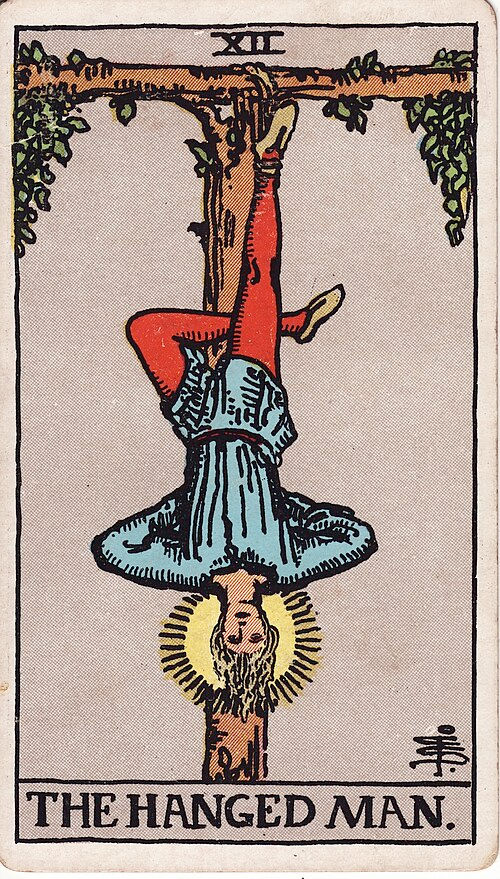
The Hanged Man is that willingness personified. The card’s image is the God’s portrait at the exact moment of the offering, after the consent and before the completion. He hangs from a living tree, not a gallows, because what he has given himself to is alive, the green year still rising through the wood that holds him. He seems to hang by his own arrangement: the free leg crossed in a shape unnatural to panic, the arms folded calmly away, the eyes open, the halo behind his head.
Nobody put him there.
He hangs suspended, neither standing nor fallen, because this is the long moment inside the giving, when the grip has been released, but the gift has not yet been received.
Walk a wheat field in the last days before the cut, and the card is everywhere. Every ripe head hangs bowed at the top of its stalk, heavy with all it gathered, waiting upon a living stem for the hand that will finish what the ripening began.
The field is full of hanged men. Each of them is the God, willing and ready.
When the card turns up for me in late summer, I read it as that willingness, asked of the querent. What are you still gripping that has already finished? Can you lay it down the way the God lays himself down, whole and on purpose, before the wind takes it instead?
One important caution comes with the card: he chose his tree. The Hanged Man is never permission for coercion, abuse, or needless suffering. It blesses only the harvest freely offered. It says nothing kind about a rope someone else tied.
The First Offering: A Lughnasadh Spread
Lay four cards in a shallow arc from left to right, the way a wheat head bows on its stalk.
1. The Standing Field. This card shows you what has ripened in your life, the thing that’s done growing even if you haven’t admitted it yet.
2. The Grip. What still has its hands around the finished thing?
3. The Cut. How to let it go, on time, with both eyes open.
4. The Bread. What your giving turns into, and who it feeds, once it has left your hands.
Nothing here is predicting your future; you’re letting the season ask you its question through your own deck.
For the Bookshelf
As an Amazon Associate, I earn from qualifying purchases.
The Poetic Edda, translated by Carolyne Larrington. If the willing sacrifice in this post got hold of you, the Hávamál is where you go next: a god hanging nine nights on a windy tree, wounded, given to himself, and coming down with the runes. Strange, spare, ancient poetry that reads faster than you'd expect. Jackson Crawford's translation is the friendlier one if you'd rather skip the notes.
The Bog People: Iron Age Man Preserved by P.V. Glob. The faces of people laid down in northern bogs two thousand years ago, which Glob reads as offerings given to the ground so it would keep bearing. Short, haunting, full of photographs, and it's this post's subject in human form.
Opened Ground: Selected Poems by Seamus Heaney. Heaney read Glob and wrote the bog poems out of it, and nobody has done better with the offered body and the ground that takes it. If the field full of hanged men stayed with you, this is the book that keeps it there.
Seventy-Eight Degrees of Wisdom by Rachel Pollack. The book most serious readers learned depth from, and still the most pleasurable long walk through the Major Arcana in print. Her Hanged Man chapter sits with the willingness and the strange peace of the card for pages, and it's the kind of writing that makes you want to pull the card to spend time with it.


Comments