The Cinquefoil: Why Five Petals Keep Appearing

Once you know what a cinquefoil looks like, you start seeing it everywhere.
It's in the stone tracery above a church door. It's punched into the tin of an old pie safe. It's stitched into the corner of a sampler, cast into an iron gate, painted on a barn, pressed into the cover of a nineteenth-century hymnal. Five rounded petals, evenly spaced, meeting at a center. Once your eye learns the shape, it stops being background. You begin to wonder who put it there, and why so many hands in so many centuries kept putting it there.
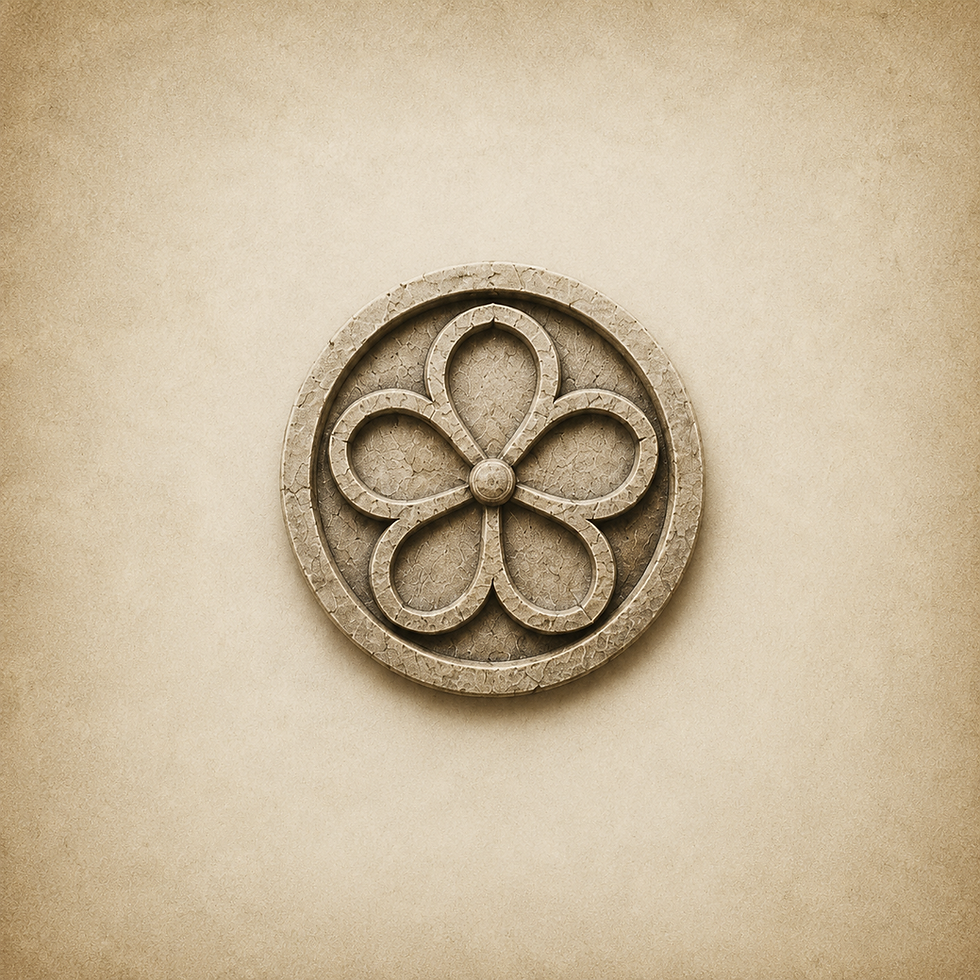
What is a cinquefoil?
The word comes from French: cinq feuilles, five leaves. It names two things at once.
First, it's a plant. Cinquefoil is the common name for Potentilla, a sprawling family of low herbs with five-petaled yellow flowers and leaves divided into five fingers. The Latin name comes from potens: powerful. Herbalists did not name a roadside weed "the powerful one" by accident. In folk practice it goes by another name still in use: five-finger grass.
Second, it's a design. In architecture and ornament, a cinquefoil is any five-lobed figure, the shape you get when five arcs meet around a shared center. The plant gave the pattern its name, and the pattern outlived nearly everything else around it.
Why five?
Five is the number of the living world. Look at the flowers of the rose family, which fed and healed medieval Europe: apple blossom, hawthorn, wild rose, strawberry, blackthorn. Every one of them opens in five petals. Cut an apple crosswise and the seeds sit in a five-pointed star. A person who spent their life in orchards and hedgerows saw fives constantly, and saw them in the things that sustained life.
Five is also the number of the body. Five fingers, five toes, five points when you stand with arms and legs spread. When medieval builders and folk artists reached for a shape that meant life, wholeness, the made world, five was already in their hands.
And five had a philosophy behind it. The Greek world counted four elements: earth, air, fire, and water. Aristotle added a fifth, the aether, the incorruptible substance of the heavens. Its Latin name, quinta essentia, survives in our word quintessence. Five is four plus one, the material world plus whatever animates it. When a modern practitioner draws a pentagram and assigns spirit to the fifth point, she is working with an idea over two thousand years old.
The Pythagoreans got there even earlier. They took the pentagram as their sign of health and recognition, and they called five the marriage number, the union of two and three, the first even number and the first odd. Centuries later, Agrippa set a human figure inside the pentagram in one of the most reproduced images in Western occultism: head, two hands, two feet at the five points. Five is the number of the human being, and the human being is a small model of the cosmos. Every meaning the cinquefoil ever held is a variation on this. Five is where matter and spirit meet, and they meet in us.
Stone
Gothic masons used the cinquefoil in window tracery, in the cusped heads of arches, in the small carved openings called quatrefoils and cinquefoils that punctuate screens and parapets. In a cathedral built to teach theology to people who could not read, no shape was decorative filler. The trefoil spoke of the Trinity. The cinquefoil, by long tradition, spoke of the five wounds of Christ, and of the five joys of Mary. A worshipper looking up at a five-lobed window was being handed a devotion in stone.
Heraldry
The cinquefoil crossed into heraldry early and stayed. It appears on shields from the twelfth century onward, one of the oldest floral charges in the system. The earls of Leicester bore it, and the city of Leicester bears it still. When the flower is drawn as a strawberry blossom it becomes the fraise, the punning badge of the Frasers. A heraldic charge had to be readable across a field at a distance, which means it had to be simple, symmetrical, and unmistakable. The cinquefoil qualified on all counts, and it carried the older associations with it: the powerful herb, the blessed number.
Folk decoration
Then it went home with people. The five-petaled flower shows up in embroidery, in fraktur, in carved chests and painted furniture, in tinwork and quilting, across cultures that had no contact with one another. Some of this is inheritance from church and heraldry. Some of it is independent invention, because a five-petaled rosette is one of the easiest satisfying shapes to make with a compass. Draw a circle, walk the same radius around it, connect the arcs. The tool teaches the shape. A farmwife with a needle and a mason with a chisel arrive at the same flower.
Protection and blessing
Here is where the plant and the pattern rejoin. Five-finger grass has been used in folk magic for centuries, and the logic of it is right there in the leaf: five fingers, so it can do what five fingers can do. It was worn or hung for protection. It was placed in the home for blessing. In hoodoo and in older European practice it draws the five blessings: love, money, health, power, and wisdom. One herb, one open hand, asking for everything a hand can hold.
The decorated cinquefoil worked the same way. A five-petaled flower over a doorway or on a marriage chest was not neutral ornament. It was a small standing prayer, a mark that said *let good things enter here*.
The first five
Before the herb, before the arch, before heraldry, there was the hand. The oldest images human beings ever made include hand stencils blown in ochre onto cave walls, tens of thousands of years old. An open hand raised palm-outward is one of the most ancient protective gestures we know, and it survives in the hamsa, in the blessing hand, in the instinctive way we still raise a palm to say stop or peace.
The cinquefoil is the hand made floral. Five points around a center. When you see one carved above a threshold, you are looking at a very old gesture in a gentler shape: a hand held up over the door.
Why it lasted
The cinquefoil persisted because it never depended on a single meaning. The mason could carve the five wounds. The herald could blazon a family's honor. The herbalist could hang five-finger grass for the five blessings. The farmwife could stitch it because it was beautiful and because her grandmother had stitched it. Each generation found its own reason, and every reason fit the same shape. A symbol that can hold that many meanings without breaking does not go out of fashion. It just keeps being made.
So the next time five petals catch your eye on a gate or a gravestone or the underside of a church pew, pause. Someone put that there on purpose. They may not have been able to tell you exactly what it meant, and they didn't need to.
Symbols survive because they continue to say something that words cannot.
For the Bookshelf
As an Amazon Associate, I earn from qualifying purchases.
An Illustrated Encyclopaedia of Traditional Symbols by J.C. Cooper. The reference I reach for first when a shape starts following me around. Cooper covers the pentad and the five-petaled flower across cultures in a few precise sentences, with none of the padding that fills newer symbol books.
Hoodoo Herb and Root Magic: A Materia Magica of African-American Conjure by Catherine Yronwode. The working reference for five-finger grass and the five blessings, written from living practice. If the cinquefoil in this post made you want the herb itself, start here.
Comments